Blog
Detroit has the will to improve its schools. Does it have the connections?
Recently, Skillman Foundation trustees and staff traveled to the state capitol for a learning visit. They met with education leaders, policymakers, organizers, and advocates to hear what it would take to accelerate community-led change in education.
For Michigan’s schools, Lansing is where many of the most important education decisions are made. It is where budgets are set, policies are shaped, and influence is exercised. It is, as the musical Hamilton says, “the room where it happens.”
That idea raises the question, who is in that room, and how does it operate?
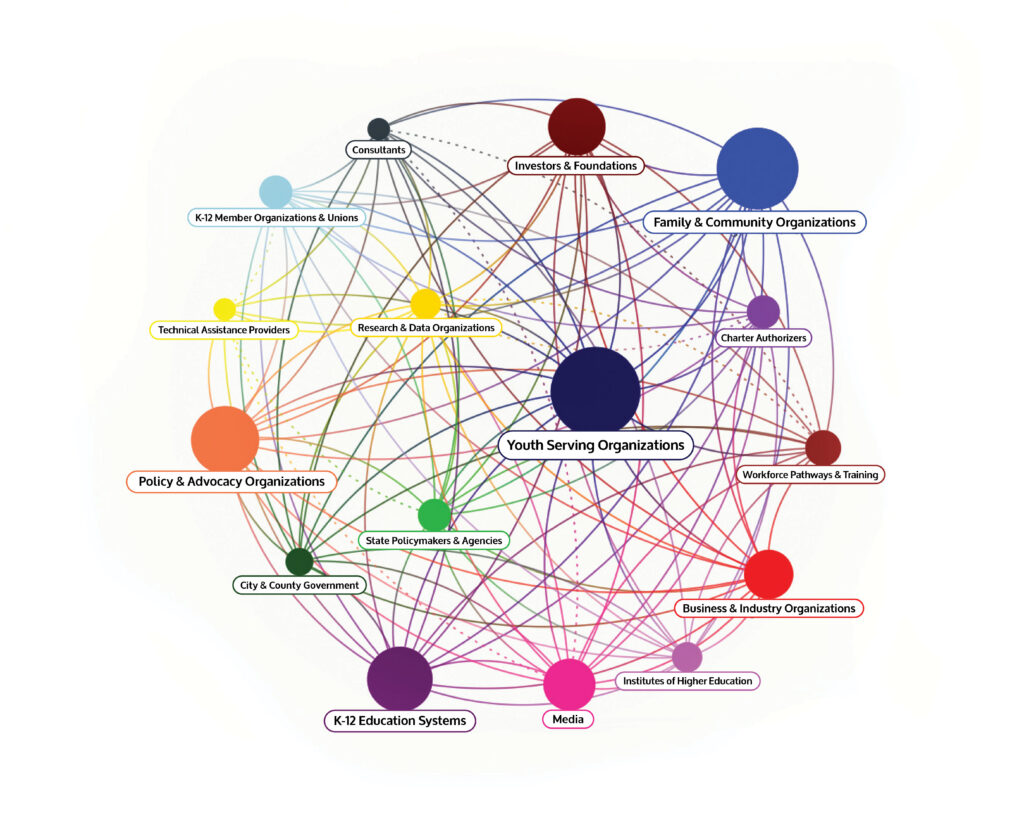
Detroit has hundreds of organizations working to improve education. What it has less of are connections between them. When we mapped how the city’s education organizations relate, only about one in seven of the possible connections was in place, and a small group of organizations did much of the work of holding the network together. Often, the organizations closest to Detroit students had the least reliable access to the rooms where decisions get made.
People Powered Education believes that when students, educators, and families work with advocates, policymakers, and system leaders to design education solutions, the results are more relevant, durable, and impactful. But belief alone is not enough. We need to understand what stands in the way of that influence becoming real.
Looking beyond who is involved to how the ecosystem works
We wanted to understand how relationships and influence function, who is structurally positioned to shape decisions, and where the conditions of the ecosystem make progress harder than it needs to be.
Between November 2025 and March 2026, Sankofa Consulting conducted 24 in-depth interviews, hosted conversations at two community gatherings, and surveyed partners across Detroit. We explored 16 sectors ranging from K-12 schools and higher education to community groups, philanthropy, business, media, and government.
The goal was to make something that is usually hard to see visible. Not just who is doing the work, but how the ecosystem operates beneath the surface.
What we found: Strength, fragmentation, and missing connections
Detroit’s K-12 education ecosystem has commitment and momentum. There are strong organizations, engaged leaders, and deep relationships within communities.
At the same time, the network is thinly connected.
- Across 117 organizations and more than 3,200 documented relationships, only about one in seven of the possible connections is in place. There are many organizations doing the work, and comparatively few ties linking them.
- The Skillman Foundation grant partners are somewhat more connected to one another than the network average, which gives the work a base to build on.
- The sectors that do the most to bridge different parts of the K-12 education ecosystem are not always the ones with the most resources or the most relationships. Being well known and being well positioned to connect others are not the same thing, and the distinction matters for advancing shared priorities.
- A small number of organizations do much of the work of holding the network together. That is a strength worth building on as well as a point of dependence: when so many connections run through a few organizations, the network is more exposed if any of them steps back.
- Many of the people who should be shaping education decisions are not yet connected to the spaces where those decisions get made.
Why youth and community voice doesn’t always shape decisions
Across interviews and network data, five patterns emerged that help explain why community voice does not always translate into policy influence.
First is timing. Parents, youth, and community leaders are often brought into conversations after key decisions are already underway. The challenge is less about whether they are invited, it is when they are invited.
Second is hidden labor. Detroit students move across multiple school systems. Of the more than 100,000 K-12 students who live in Detroit, 38% attend Detroit Public Schools Community District, 26% attend Detroit charter schools, and 36% attend public schools outside the city through Schools of Choice. Without shared infrastructure, families must navigate enrollment, transportation, and transitions across these systems. This takes time and energy, leaving less capacity to push for systemic change.
Third, data and lived experience are not always connected. Community knowledge is present and often acknowledged, but it is not consistently integrated into decision-making or treated with the same weight.
Fourth, trust does not equal influence. Community organizations in Detroit have deep credibility and strong relationships. What is often missing are structural processes that connect that trust to formal decision-making power.
Finally, narrative shapes what’s possible. The dominant story about Detroit education influences which solutions gain traction, whose leadership is seen as credible, and which structural conditions go unquestioned. Changing outcomes will require changing that story and who controls it.
What this study makes possible
This study is meant to be used. It is a tool to help ensure youth and community have access to the room and improve what happens once they are there.
It does that in three ways.
First, it offers a shared picture of how the ecosystem currently works. The network analysis provides a shared view of how connections and influence are structured. It highlights where alignment is possible and where gaps remain. One practical tool is the interactive network map, available at skillman.org/ecosystem-map, which allows partners to understand their position, identify potential collaborators, and see where they can play a bridging role.
Second, it creates a shared language for what needs to change. The five dynamics offer a way to describe structural barriers in concrete terms. They shift the conversation from isolated challenges to systemic conditions that shape outcomes across the system.
Third, the findings point to a path for long-term investment. The findings point to areas that require sustained commitment, including cross-sector coordination, parent organizing, stronger data systems, and clearer pathways from community voice to policy action. These are not quick wins. They are long-term efforts that must continue across leadership and political cycles.
Reimagining the room: What each of us can do
Detroit already has many of the pieces needed for change. The opportunity is to connect them more intentionally.
- Policymakers can create earlier and more meaningful entry points for community input and voice.
- Funders can invest in infrastructure that supports long-term alignment.
- Organizations can build stronger connections and coordinate around shared priorities.
- Parents, youth, and community leaders can use this work to better understand where there are opportunities to connect their grounded knowledge of Detroiters’ needs to decision makers seeking to enable positive change for families and students.
System change happens when people move together with a shared purpose over time. This study is a step toward making that possible.
Explore the interactive network map at skillman.org/ecosystem-map.
Laila Bell & Paul Miller
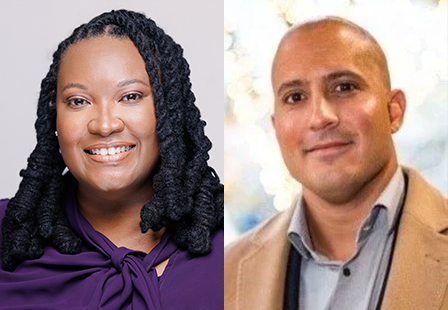
Laila Bell (left) joined The Skillman Foundation in March 2023 as the inaugural vice president of learning & impact. In this role, Laila designs the Foundation’s approach to using data, evidence, and experience to inform investments in the power of Detroit youth to create and influence change. Paul Miller (right) is a senior program officer at Sankofa Consulting where he leverages over 15 years of experience in strategic planning, program management, and evaluation to help clients develop customized solutions that enhance educational outcomes and promote equity.
Increddible work! <3