Blog
More Than a Grant: Learning to Invest in Detroit’s Young People
Lucy Stern is a member of the 2025-2027 Skillman Youth Council and serves on the Council’s Storytelling Committee.
Grantmaking might not be the first thing that comes to mind when you think about what a group of high school students can accomplish. But for the Skillman Foundation Youth Council, it became an opportunity to learn something entirely new, discover the work happening throughout our community, and take part in decisions that could make a difference in the lives of other young people.
The Process
Our journey began with a simple question: What exactly is grantmaking? Before we could decide which organizations to support, we needed to understand what went into the process. We explored different types of grantmaking, learned how funding is used to support organizations and communities, and discussed what we wanted our own approach to look like. It wasn’t just about choosing where money should go. It was about understanding the needs around us, deciding which issues mattered most, and figuring out how we could use the opportunity in front of us to support meaningful work.
We wanted our grantmaking to support students moving through late middle school, high school, and into early college. We thought about how much can change during those years, and how important it is for young people to have access to guidance, resources, and opportunities as they grow. So we created the FUNDamental Futures Fund which focused on academic support, mentorship, and mental health for youth in those key age groups. Our goal was to support organizations who are serving youth through transitional stages so that students aren’t left behind or expected to navigate each new stage entirely on their own.
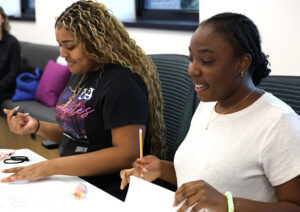
Once the applications came in, we had the chance to see the work being done throughout Detroit firsthand. Reading through the responses introduced us to organizations and programs that many of us had never encountered before. Others were familiar names, but looking more closely at their work gave us a better understanding of the youth they serve and the impact they hope to make. For Analeise Martinez, discovering these organizations was one of the highlights of the experience. “Reading the responses were super fun because I learned about organizations in our community that I never knew existed before,” she shared. DeRick McCalebb also appreciated the opportunity to look more closely at organizations he already knew, explaining, “I learned specific information about all of our organizations. I already knew most of them, but learning more or going deeper helped me learn new things about all of the organizations.”
Of course, learning about all these organizations also meant we had some important decisions to make. We couldn’t support everyone, so we needed a thoughtful way to evaluate the applications and determine which organizations most closely aligned with the goals we had established. We held a series of voting sessions, moving between different stations where members reviewed organizations using several criteria designed by the Youth Council. It was a collaborative process that asked us to look beyond first impressions, consider different perspectives, and think carefully about where funding could make the greatest difference.
For Matthew Johnson, the experience brought a new understanding of the responsibilities involved in grantmaking, from structuring a grant to identifying organizations that genuinely connected with the issues the Council wanted to address. He also found himself learning to trust his own judgment rather than second-guessing himself, a habit he humorously calls “matthewnizing” himself. Despite the challenges, he reflected positively on the experience, sharing that he was excited to “see the outcome of our decisions and hard work.”
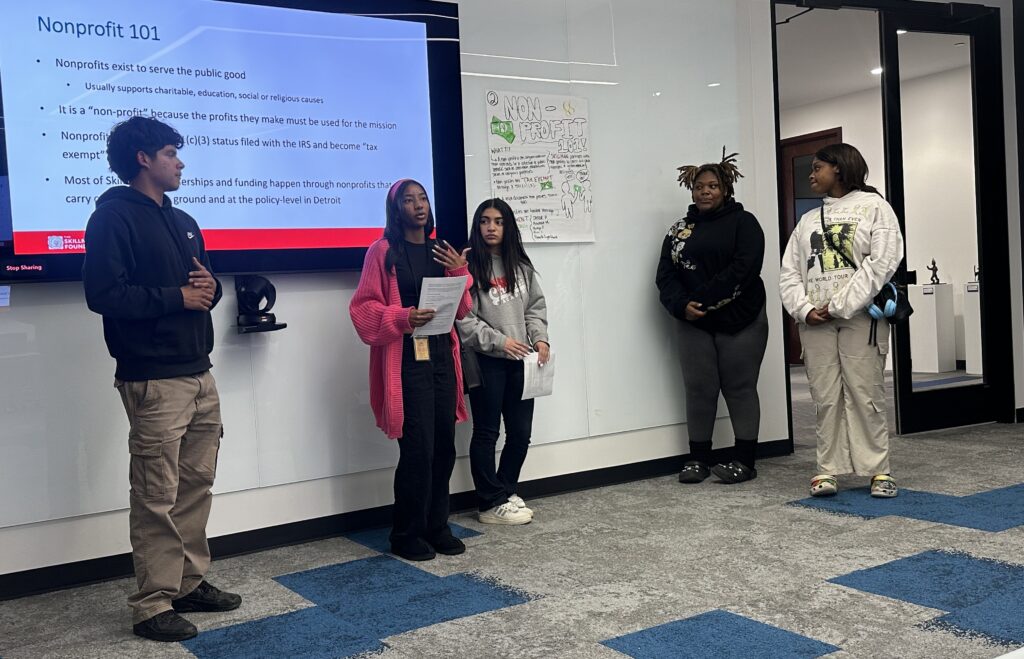
The work also extended beyond reviewing applications. Members participated in subcommittees that contributed to the larger grantmaking process. Analeise, for example, enjoyed creating the flyer for the storytelling committee. Matthew described the research committee’s role in examining the factors affecting education for young people, using data to identify issues and establish the values that would guide the grant. He explained that this involved reaching out to other committees, sharing perspectives, and eventually bringing the research together into a presentation and group discussion. Each contribution helped shape a different part of the process, reminding us that grantmaking is not the work of one person or one committee, but a collective effort.
Impact in Our Community
But beyond the applications, meetings, and voting, the question that stayed with us was a much bigger one: What does it mean to have a hand in supporting your own community?
For Analeise, the answer came down to the possibility of making someone’s day a little brighter. She described her impact as a form of service, imagining that somewhere in Detroit, a group of teens might be enjoying a program supported by the Council’s decisions. As she put it, “Maybe a group of kids are having a good time right now at the organization, and knowing that I may have been able to play a small role in someone’s happiness and hopefully impact their life in a small way, feels super rewarding.” Brooklyn Williams reflected on her contribution, saying, “I helped with the systems we used to organize the nonprofits’applications.” DeRick saw the experience on an even broader scale: “Through grantmaking we have effectively made the world a better place. By giving to the nonprofit organizations that we see the most potential in.”
Matthew offered another perspective, reflecting on what it means for young people to be trusted with this kind of responsibility. He described youth participation in grantmaking as an “eye opener,” explaining that young people have concerns, worries, and thoughts about the communities and world they live in, even when adults don’t always recognize them. He hopes that experiences like this can challenge assumptions about younger generations and create more opportunities for youth to participate in meaningful decisions. As he reflected, “I believe we’re heading to a direction of healing or realization.” It is a powerful reminder that including young people in community decisions does more than give them a new responsibility; it gives others the opportunity to see what they are capable of contributing.
Grants Awarded
After months of learning, researching, reviewing applications, and making decisions together, we are excited to share the organizations selected for funding. $300,000 in grants were awarded to 30 nonprofits serving Detroit youth:
- Glean for Teens ($13,000)
- Latin Americans for Social & Economic Development Inc ($13,000)
- 1 Michigan for Global Majority ($10,300)
- Association for the Advancement of Deaf/Hard of Hearing (AADHH) ($10,300)
- B & B Community Services ($10,300)
- Black United Fund of Michigan, Inc ($10,300)
- Boys Hope Girls Hope of Detroit ($10,300)
- Caleb’s Kids ($10,300)
- Childs Play Foundation ($10,300)
- Click Afterschool ($10,300)
- Detroit African Youth Development Organization ($10,300)
- Detroit Association of Black Organization, Inc. ($10,300)
- Detroit Catholic Pastoral Alliance (Fiscal Sponsor for Epiphany Education Center) ($10,300)
- Detroit Food and Entrepreneurship Academy ($10,300)
- Developing Despite Distance ($10,300)
- Friends of the Children – Detroit ($10,300)
- InsideOut Literary Arts ($10,300)
- L!FE Leaders, Inc. ($10,300)
- L.I.V.E. Outreach ($10,300)
- Minority Freedom Community Fund ($10,300)
- The Austin Foundation ($10,300)
- The Men Who Dare ($10,300)
- The Mercy Education Project ($10,300)
- The Peoples Action ($10,300)
- The Price Project ($10,300)
- Tone Foundation ($10,300)
- Islamic Center of Detroit ($6,700)
- Que Blackout Theatre ($6,700)
- Racquet Up Detroit ($6,700)
- The Konnection ($6,700)
Reflection
Each selection represents more than a funding decision. It reflects the time, thought, and care that went into understanding the needs of young people and identifying organizations working to meet them.
Our first grantmaking experience taught us that supporting a community is about much more than distributing resources. It begins with listening, asking questions, learning from one another, and being willing to take responsibility for the decisions we make. We started with very little experience in grantmaking, but we finished with a deeper understanding of the organizations serving Detroit, the challenges young people face, and the importance of making space for youth perspectives in decisions that affect our lives.
Maybe the greatest lesson was that young people don’t have to wait until they are older to make a difference. Given the opportunity, they can learn, lead, and invest in the communities they already call home. And sometimes, that is where meaningful change begins.