
Data & Learning
From Disconnected Data to Common Ground
From Disconnected Data to Common Ground
Michigan’s first Special Education Benchmark Report builds a shared understanding of how Michigan supports students with disabilities.
This story is a part of our 2025 annual report.
For years, the Autism Alliance of Michigan (AAOM) kept hearing similar stories from families across the state.
Parents of children with disabilities described difficulty accessing services, inconsistent implementation of Individualized Education Programs (IEP), limited inclusive opportunities, and very different experiences depending on where they lived.
For Heather Eckner, AAOM’s director of statewide education & outreach, the question was how to show others that the experiences families were describing were not isolated, but part of a broader pattern across Michigan’s special education system.
AAOM first tried to answer that question by listening more systematically. In 2024, nearly 900 people responded to its statewide Special Education Experience Survey, helping document what families were experiencing every day. Eckner wanted to pair those lived experiences with a broader view of what the system itself was reporting.
“What does the system itself tell us?” she recalled asking. “We need a baseline. We need a benchmark report.”
Michigan already collected an enormous amount of special education data. The challenge was that the information was scattered across state and federal systems. Graduation rates lived in one place, assessment results in another, with still more data housed elsewhere on inclusion, family engagement, dispute resolution, and other measures.
“What was missing was that coherent picture,” Eckner said. “That fragmentation is its own systemic barrier.”
The lack of a clear, accessible picture made an already complex system harder to navigate for everyone, from researchers trying to compile the data to families trying to understand what it meant for their children.
In 2025, with support from The Skillman Foundation, AAOM created the inaugural Michigan Special Education Benchmark Report to bring all that publicly reported data into one place and establish a baseline for measuring progress.
The report found that about 1 in 7 Michigan public school students has a disability, and that share is growing even as overall enrollment declines. It also found that students with disabilities graduate at lower rates than their nondisabled peers, 60% compared with 85%, and drop out at nearly twice the rate, 21% compared with 11%. Proficiency gaps reach 27 percentage points in math and 32 points in English language arts.
At the same time, 73% of Michigan students with disabilities spend at least 80% of their day in a regular classroom, above the national average. That contrast raises an important question: access and inclusion matter, but are students getting the instruction and support they need to succeed once they are there?
Taken together, the findings revealed a systemic pattern and gave families, educators, administrators, and policymakers a common factual foundation for understanding and enabling collective action.
That shared understanding is especially important in an education policy environment where people often come to the table with very different experiences and explanations for what is happening.
For years, families had raised concerns with education leaders, only to hear that their experience might be unusual or confined to one school or district. The Benchmark Report allowed those experiences to be considered alongside statewide data.
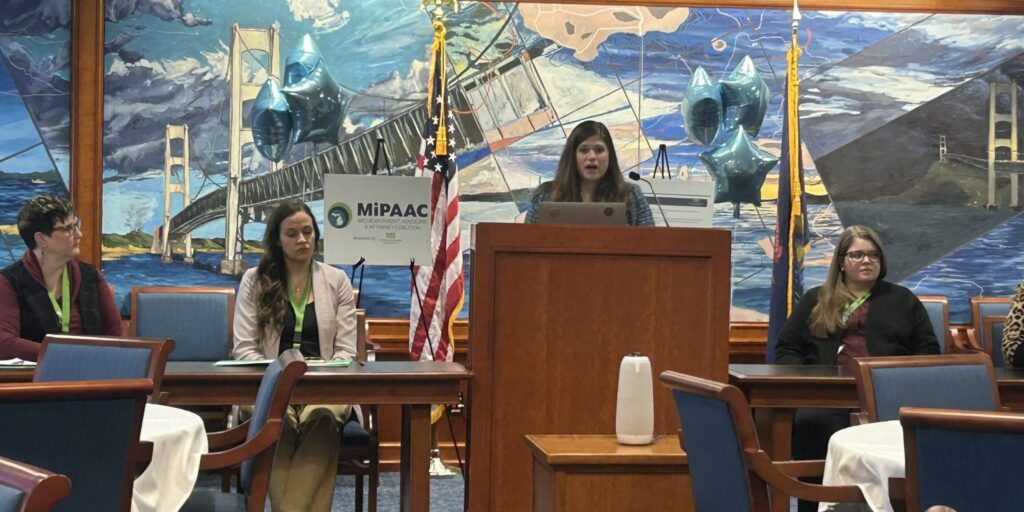
“The Special Education Experience Survey and the Benchmark Report together gave us a fuller picture of what was happening across the system. We had families telling us what they were experiencing, and statewide data showing those same patterns. That combination is really powerful,” said Eckner.
With a clearer understanding of the problem, AAOM has also been able to push the conversation toward solutions. That includes the MI Special Education Finance Reform Blueprint, which was authorized by the Michigan Legislature to develop a more student-centered approach to funding special education. The Benchmark Report shows what the current system is producing for students, while the Blueprint lays out a forward-looking framework to align funding more closely with student need.
More than 50 years after the Individuals with Disabilities Education Act (IDEA) guaranteed students with disabilities access to public education, Eckner believes Michigan should expect more than access alone.
“We can check the access box, but what has it produced?” Eckner asks.
IDEA, she says, should be the “basement floor, not a high ceiling.” Students with disabilities should have the same fundamental expectations as any other student: to learn, participate, graduate, and leave school prepared to build the life they want.
That is also why Eckner believes special education belongs at the center of Michigan’s larger conversation about public education.
“If we mean it when we say we want to improve public education in Michigan, then how we serve students with disabilities has to be at the forefront of that work. If we can get the system right for students who have faced some of the greatest barriers, we’re going to make the system better for everyone. The Benchmark Report gives us a shared understanding of where we are today and common ground for figuring out where we go next.”