
Coalition for the Future of Detroit Schoolchildren

In December 2014, a diverse group of Detroiters from the city’s education, corporate, philanthropic, and social sectors came together to create a comprehensive plan to improve the city’s schools.
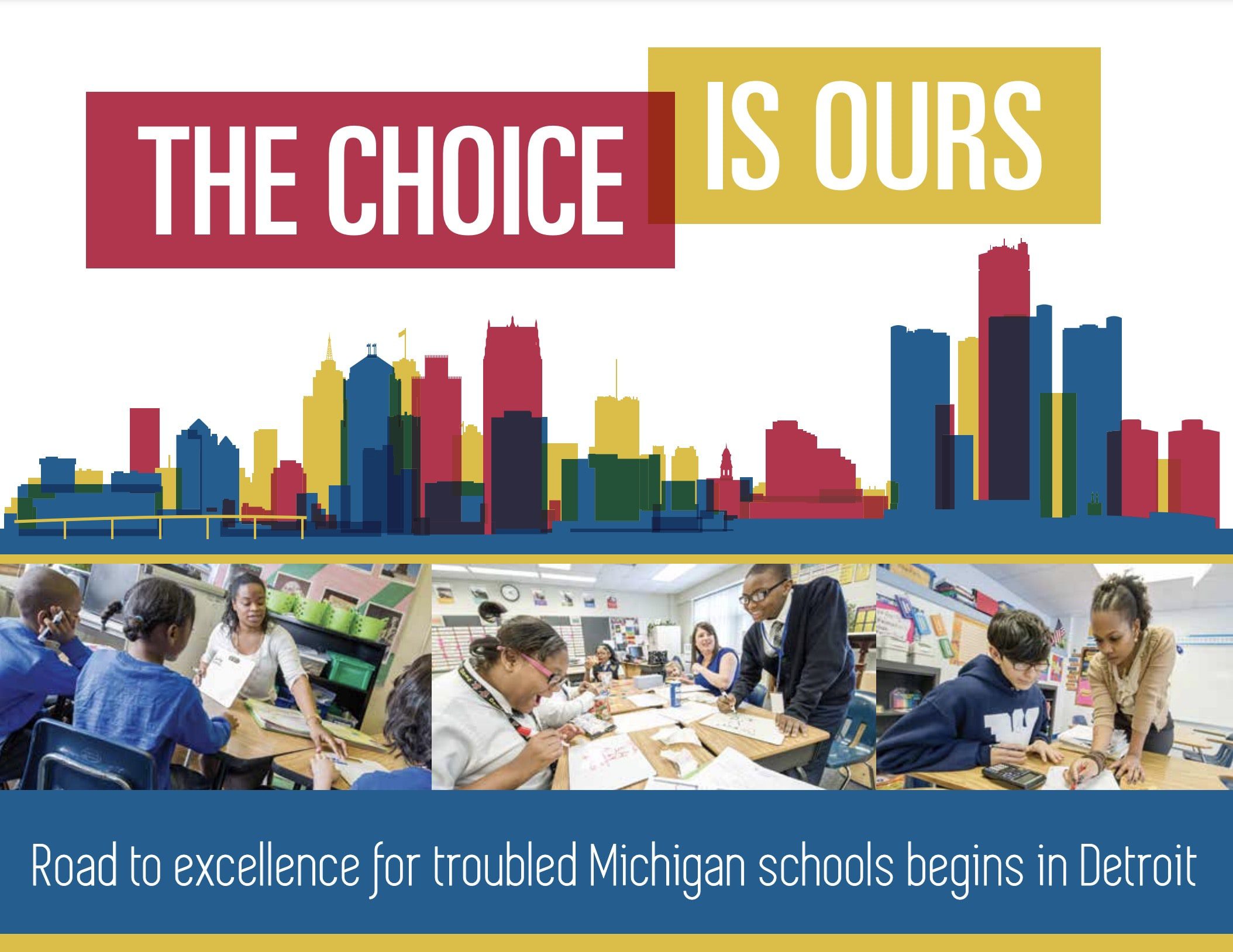
Within 90 days, the Coalition met with over 150 Detroit parents, educators, and community members to craft and pressure-test recommendations. These were published in the 2015 report, “The Choice is Ours.”
The recommendations came at an urgent time. Detroit Public Schools faced bankruptcy and had been under the control of emergency managers since 2009. A proliferation of charter schools had opened and closed without much coordination or accountability. The city’s student population had shrunk by about
Coalition members and allies spent a year and a half urging state lawmakers to take up the policy recommendations.
In particular, they advocated:
● The state should assume the Detroit Public Schools’ debt, which was largely accrued while the district was under state-appointed emergency management.
● Return governance of Detroit Public Schools (DPS) to an elected school board.
● Create a new nonpartisan entity, the Detroit Education Commission, to oversee coordination, quality, and community input across DPS and charter schools.
In June 2016, Detroit schools legislation was passed. The state assumed the DPS debt, created a new debt-free district, and returned control to a locally elected school board, which would appoint a new superintendent.
While much headway was made, the bills fell short of the reforms envisioned by the Coalition–in particular, the creation of a Detroit Education Commission to oversee accountability and coordination across the city’s fractured education landscape.
Coalition 2.0
On the tailwinds of the state legislative action, the Coalition for the Future of Detroit Schoolchildren banded together again, colloquially called “Coalition 2.0.” While many original members stayed on board, new leaders also stepped in (see page 11 for the list).
It again conducted extensive research, including soliciting input from hundreds of Detroit educators, parents, and leaders of businesses, civic and faith-based organizations, organized labor, government agencies, and philanthropic foundations.
This time, the Coalition focused on actions that Detroiters could take to strengthen the schools in their community. It published recommendations in a new report, “Our Schools, Our Moment.”
Coalition 2.0 laid out six priorities:
- Student attendance
- Attracting educator talent
- Third-grade literacy
- College and career pathways
- Fully funding special education
- Improved coordination and accountability across Detroit Public Schools and charter schools
These priorities were led by a number of groups and organizations. For instance, the coalition Every School Day Counts Detroit worked with schools and community partners to raise student attendance. Teach 313 launched as an educator talent attraction and retention program. 313Reads! banded together as a coalition to raise grade-level literacy. The Detroit College Access Network continues to support Detroit students in their transition to postsecondary education. Grow Detroit’s Youth Talent, a partnership between the City of Detroit and multiple employers and funders, continues to introduce young people to the workforce with paid work experiences. Many education advocates have steadily worked to bolster special education supports, recommending data-informed special education funding levels and ways to achieve them—like increased Medicaid disbursements for in-school student supports. The Community Education Commission, a nonprofit created by the Detroit Mayor’s Office, helped break down barriers standing in the way of Detroit families from finding the right educational opportunities for their children. The list of examples goes on.

The Coalition for the Future of Detroit Schoolchildren exemplified the power of a broad, diverse collection of leaders and organizations banding together to set a shared vision and priorities and to align actions toward them. The relationships and many of the initiatives sparked by Coalition 2.0 have carried on through the years, improving the quality of education in Detroit and beyond.
Media
In The News
- Detroit Group Calls for Overhaul of Schools – The New York Times
- Coalition: Put control of DPS back in the hands of Detroiters – Michigan Radio
- Why you should pay attention to a new coalition’s recommendations for education in Detroit – ModelD
- Coalition supporting Detroit schools a step in the city’s road back – Bridge Michigan
- Coalition Calls for Local Control, Broad Reform of Detroit Schools – Philanthropy News Digest
- Coalition recommends state take on Detroit schools debt, create city education commission – MLive
- Mich. Gov. Rick Snyder Creates New ‘District’ to Oversee Detroit Schools – Education Week
- Detroit Mayor: End State Oversight of City Schools – Education Week
- Detroit Mayor Says It’s Time to End Emergency Management of Schools – Governing Magazine
- Report: DPS Needs More Teachers and Better Pay – WDET
- Skillman Foundation CEO Hopeful About Detroit Education Reform – Philanthropy News Digest
- Does State School Reform Have a Democracy Problem? – Emerging Practitioners in Philanthropy
- Leaders of coalition exploring education in Detroit confident they can complete ‘ambitious’ plan – MLive
- Education is key to closing opportunity gap – Crain’s Detroit Business
- Detroit Education Commission set to anchor Detroit Schools – WDET Radio
- Group to call for reforms in Detroit education – The Detroit News
- Group: Detroit must focus on literacy, growing schools – The Detroit News
- A year after the tearful demise of a proposed Detroit school oversight commission, backers seek another way to bring order to Detroit schools – Chalkbeat Detroit
- Cross-sector organization calls for district-charter cooperation in Detroit – K12 Dive
- Coalition recommends coordination between Detroit schools, putting emphasis on reading – Detroit Free Press
- Coalition calls for new steps to improve K-12 education in Detroit – Michigan Radio
- Detroit city leaders to district and charter schools: Please work together to improve education for kids – Chalkbeat Detroit